

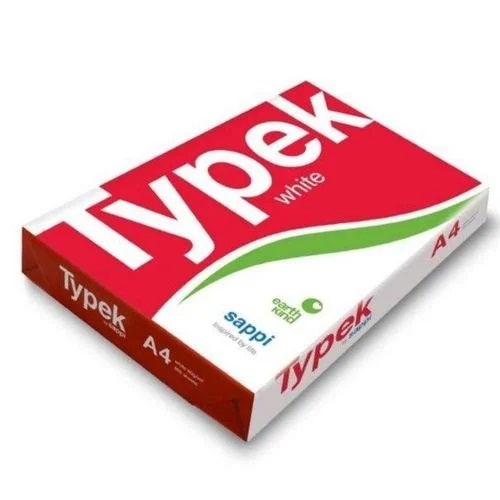
A distributor called us last year convinced their supplier had swapped mills without telling them — same box, same label, paper that suddenly curled in their laser printers after six good months. It hadn’t. What had changed was storage conditions at a transshipment port, not the paper itself. That call is basically why this article exists: Typek A4 copy paper gets a lot of loyalty from buyers who’ve used it for years, and most of what goes wrong with it in the field has nothing to do with the paper leaving our mill.
We supply and export Typek A4 copy paper to offices, schools, print shops, and distributors worldwide, and this is the same conversation we’d walk a new buyer through before a first order — not a rewritten spec sheet pulled from a catalog.
What Typek A4 Copy Paper Actually Is
A4 is the fixed international sheet size, 210 by 297 millimeters — that part doesn’t change between brands. Typek built its reputation as a dependable, everyday office paper: not the flashiest brand on a shelf, but one that consistently does what it’s supposed to do without drama. That reputation is earned through manufacturing discipline more than marketing, and it’s a big part of why so many long-standing distributors keep reordering Typek paper year after year instead of chasing whatever’s cheapest that quarter.
When a customer specifically asks for Typek paper rather than “just A4,” it’s usually because they’ve used it before and know what to expect from it — smooth feed, consistent brightness, and a sheet that doesn’t surprise them halfway through a print run.
The Specs That Actually Matter
Most buyers skim a spec sheet without really absorbing what each number means. Here’s the short version.
Weight (GSM): Grams per square meter. We supply Typek paper in 70, 75, and 80 GSM. Lighter weights suit high-volume internal printing; heavier weights suit anything that needs to feel more substantial in hand.
Brightness: Measured against an ISO brightness scale, typically in the high-90s to low-100s percentage range for this grade. Higher brightness produces sharper-looking black text and more vivid color output, which matters more than people expect once they’re comparing two reams of Typek paper side by side.
Opacity: How much text shows through from the reverse side of the sheet. Low opacity ruins double-sided printing — you end up with faint ghosting from the other page bleeding through, which looks unprofessional on anything client-facing.
Sheets per ream: Standard is 500 sheets, packed 5 reams to a carton — 2,500 sheets per carton — though we can adjust carton counts for large wholesale orders.
Moisture content: The quiet variable nobody asks about until it causes a problem. Paper that’s absorbed humidity during transit or storage feeds inconsistently no matter how well it was manufactured.
Choosing Between 70, 75, and 80 GSM
This is the question that comes up on almost every first call with a new account.
70 GSM Typek paper is the lightest, most economical option, suited to high-volume, lower-stakes printing — internal memos, drafts, anything read once and filed away. It performs perfectly well; it’s just not what you’d hand a client.
This 75 GSM version of Typek paper sits comfortably in the middle and is the sensible default when you’re not sure what to order. It handles duplex printing better than 70 GSM and runs reliably across nearly every laser and inkjet machine we’ve tested.
80 GSM is the heavier option, and it’s what we recommend for anything that leaves the building — proposals, signed agreements, presentation packs. It has a more substantial feel and better opacity, and it simply reads as more deliberate the moment someone picks it up.
Plenty of offices default to one GSM across the whole operation because it’s simpler to manage, but the accounts that get the most value out of it tend to split their stock — lighter weights for internal volume, heavier for anything client-facing.
Why “Jam-Free” Actually Means Something Here
Every paper brand claims to be jam-free, and the phrase has been worn down until it barely registers. So let’s be specific about what actually causes a jam.
Three things, mostly: moisture, cut precision, and static. Humid storage makes sheets stick and misfeed. Imprecise cutting at the mill leaves sheets slightly off-square, which throws off the feed rollers. Poor static conditioning causes multiple sheets to grab at once instead of a single clean sheet.
Typek A4 copy paper is manufactured with FSC-certified fiber and packaged specifically to control moisture and cut precision at the source, which is part of why it performs consistently across different printer brands rather than being tuned narrowly for one machine. That’s also why we’re careful about how pallets of Typek paper are stored and shipped — a ream that sat in a humid container for six weeks won’t behave like one that left the mill last week, regardless of how good it was originally.
Storage and Handling
Paper doesn’t expire the way food does, but it absolutely loses performance if handled carelessly. Keep reams sealed in their original wrap until you’re ready to load them — that wrap is a moisture barrier, not just packaging. Store cartons somewhere with stable temperature and humidity, off the floor, away from exterior walls where condensation tends to build.
If you’re a distributor holding stock, rotate it — oldest cartons out first. We’ve had customers open a container after months in a non-climate-controlled warehouse and blame a “bad batch,” when the paper left our facility in perfect condition and the storage conditions afterward did the damage.
We pack Typek paper in standard 500-sheet reams, sealed against moisture, boxed into cartons for palletizing, and we’re happy to discuss custom carton counts for large export orders where your logistics setup calls for something different.
Who Actually Buys This Paper
“Offices” is the easy answer, but the real customer base runs wider. Corporate offices form the obvious core, usually splitting GSM by department — daily invoicing doesn’t need what the boardroom uses for a client deck. Schools and universities move enormous volume through 70 and 75 GSM for handouts and administrative paperwork, where cost per ream outweighs premium feel. Print shops and copy centers care about consistency above almost everything else, since their whole business depends on a ream behaving the same way, order after order.
Then there’s the resale layer — stationery retailers, office supply chains, and distributors buying in bulk and breaking it down for their own customers. A meaningful share of who orders Typek paper from us directly falls into this group, because a lot of retail-facing businesses would rather work with an exporter who handles logistics than deal with a mill directly.
Sustainability and Sourcing
This is one area where Typek genuinely leans into its manufacturing story rather than treating it as an afterthought. Pulp for Typek A4 copy paper is sourced from responsibly managed forestry consistent with FSC certification standards, which increasingly matters for procurement teams in Europe and North America where sustainability documentation is sometimes a contractual requirement rather than a nice-to-have.
If your organization needs that documentation as part of a formal procurement process, we can supply it alongside a wholesale quote — it’s a routine part of ordering Typek paper from us at this point, not a special request that slows anything down.
How Bulk and Export Ordering Works

If you’re buying a ream at a time, none of this applies to you — go to a retailer. This is for businesses, schools, and distributors ordering by the carton, pallet, or full container.
Ordering Typek paper in bulk usually starts with a short conversation: volume, GSM mix, destination, timeline. From there we build a quote that accounts for freight, and depending on order size, we’ll talk through container logistics, customs documentation, and delivery scheduling — including staggered shipments if a single lump delivery doesn’t suit your storage capacity.
We export Typek A4 copy paper worldwide, not to any single region, so the process is broadly the same regardless of where you’re ordering from. The main variables are shipping method — sea freight for volume, air for smaller urgent orders — and destination port handling.
Minimum order quantities exist because of how freight economics actually work, not to shut out smaller buyers. If you’re unsure whether your volume makes more sense as a direct order or through a regional distributor, ask us — we’d rather point you the right direction than push a container order on someone who needs two pallets.
What Actually Separates One Supplier From Another
On a spec sheet, most A4 copy paper looks similar across suppliers. The real differences show up in three places: batch-to-batch consistency, how a supplier handles a shipment that arrives damaged or short, and whether the person answering your email actually understands paper or is relaying messages to someone else.
Batch consistency matters more than people expect until it’s cost them something. A supplier shipping 80 GSM that measures 78 in one order and 82 in the next creates real headaches for anyone downstream who’s calibrated a process around a specific weight. We manufacture Typek paper to tight GSM tolerances specifically because our repeat wholesale accounts need that consistency more than they need a marginally lower price on a one-off order.
Honest Notes Before You Order
We won’t pretend every ream that’s ever left a mill has been flawless. Typek paper is a manufactured product, and occasionally something slips — a slightly off-center cut, a carton knocked around in transit. What matters is how it’s handled when it happens: we replace it, we don’t argue about it, and we’d rather absorb the cost of a damaged carton than lose a wholesale relationship over a dispute.
If you’re comparing suppliers, ask direct questions about GSM tolerance, moisture packaging, and what happens when a shipment arrives damaged. The answers tell you more than any spec sheet will.
A Word on Mislabeled Stock
Because established paper brands carry recognition in a lot of markets, they’re also a target for mislabeled or lower-grade stock sold under a familiar name — reams wrapped to look right but never actually manufactured to the stated specification. We’ve seen mislabeled Typek A4 copy paper turn up in regions with looser enforcement, and it’s a genuine headache for legitimate buyers comparing quotes, since two “identical” reams from two suppliers can be nowhere near the same actual product.
The fix is unglamorous but effective: ask for a specification sheet, ask where the pulp is sourced, and treat an unusually low price against everyone else’s quote as a question rather than a bargain. We send documentation with every wholesale quote for Typek paper — GSM tolerance, brightness rating, moisture content at packaging — because we’d rather a buyer compare us properly than choose on price alone and get burned by someone else’s mislabeled stock.
Common Mistakes First-Time Bulk Buyers Make
The same handful of mistakes show up repeatedly with new wholesale accounts.
The first mistake buyers make with Typek paper is ordering one blanket GSM for an entire operation without accounting for how different departments actually use paper. It’s simpler to manage on paper, but it usually surfaces later as a complaint that client documents “feel cheap.”
The second is underestimating storage requirements. A buyer orders a full container of Typek A4 copy paper, stores it somewhere without climate control for months, and then blames a “bad batch” for jams that were actually caused by humidity absorbed after it left our facility.
The third is leaving lead times too tight. Sea freight isn’t instant, and if inventory is planned around a school term or a fiscal-year procurement cycle, ordering three weeks out is cutting it closer than most people realize once customs clearance gets added to the timeline.
FSC Certification and What It Actually Means
A lot of buyers see an FSC label and treat it as a box checked without understanding what it actually verifies. FSC certification tracks a chain of custody — meaning the wood fiber in the paper can be traced back to forestry operations audited against defined environmental and social standards, not just a general claim of being “eco-friendly” with no verification behind it.
For Typek paper specifically, that certification is part of why some institutional buyers — universities, government departments, larger corporates with procurement policies — specify it by name rather than accepting any A4 paper that meets basic brightness and weight specs. If your own procurement process requires chain-of-custody documentation, that’s something we can provide alongside a wholesale quote without turning it into a lengthy back-and-forth.
Quick Answers to Questions We Get Asked a Lot
Can I mix GSM weights in one order? Yes, and most wholesale buyers do. Ordering a mix of 70, 75, and 80 GSM Typek paper across departments is completely normal.
Does Typek paper work in both laser and inkjet printers? Yes, it’s manufactured to perform across both, though for very high-volume laser printing, 75 or 80 GSM tends to feed more reliably than 70.
What’s the minimum order for export? It depends on destination and shipping method. Send us a target quantity and we’ll tell you plainly whether a direct order makes sense or whether a regional distributor would get you a better price.
How long from quote to delivery? It varies by destination and current freight schedules. We give a realistic timeline with the quote rather than a generic estimate, since sea freight delays are common enough to plan around honestly upfront.
Cost Per Ream Isn’t the Whole Story
Most procurement decisions get made on cost per ream because it’s the easiest number to compare across quotes. It’s worth running the math on cost per successful print instead, because a cheaper ream that jams more often, or requires a reprint due to poor opacity, ends up costing more in wasted toner, wasted time, and wasted paper than a slightly pricier ream that just works the first time.
This isn’t an argument for overpaying. If 70 GSM Typek A4 copy paper genuinely fits your use case, buy 70 GSM. But if you’re choosing between two 80 GSM quotes on a few cents’ difference per ream, ask about GSM tolerance and moisture packaging first — that’s usually where the real difference between suppliers actually lives.
What a Typical First Order Looks Like
New wholesale accounts tend to start smaller than they eventually settle into, and that’s a sensible way to do it. A first order is often a partial container or a mixed pallet, enough to confirm Typek paper performs the way we’ve described it, on your actual machines, with your actual staff, before committing to a full container on a recurring schedule.
We’d rather earn a second order than oversell a first one. Once a buyer has run a trial shipment and confirmed fit, most move to standing orders on a monthly or quarterly cadence, which also tends to smooth out pricing since we can plan production and freight further in advance rather than reacting to one-off requests.
Packaging Options for Different Markets
Not every buyer wants the same box. A distributor reselling into a retail environment usually wants standard branded ream wrap and carton labeling that customers recognize on a shelf. A corporate buyer ordering for internal use mostly cares about the carton surviving a loading dock and a freight elevator without damage. A government or institutional buyer sometimes needs specific documentation printed on the carton itself — country of origin, batch number, compliance markings — for their own procurement records.
We can accommodate most of these variations for Typek paper without turning it into a custom manufacturing run. Standard carton counts, ream wrap, and labeling cover the majority of orders, and where a buyer needs something specific — private labeling, a particular carton count for a warehouse racking system, extra moisture protection for a humid destination port — that’s a conversation we have upfront during quoting rather than something that gets discovered after the container has already shipped.
Recycled vs Virgin Pulp
Some buyers ask specifically whether Typek A4 copy paper uses virgin or recycled pulp, usually because their own procurement policy has a stated preference either way. Virgin pulp generally produces a brighter, smoother, more consistent sheet across large batches, which is part of why most premium copy paper leans virgin rather than recycled. Recycled content has improved substantially over the last decade, but tends to run slightly lower on brightness and can vary more batch to batch, since the recycled input stream itself isn’t perfectly uniform.
We’re happy to discuss either option depending on what your organization’s sustainability policy actually requires — some procurement rules have hard recycled-content minimums written in, and we’d rather know that upfront than send a quote that doesn’t match what you’re permitted to buy.
Getting a Quote

If you’re ready to move, the fastest route is our Typek A4 copy paper product page, where you can send your quantity and destination directly. You can also reach us through our contact page for a more detailed conversation. To see the rest of our catalog — A3 sizes, thermal rolls, and specialty letter and legal formats — our homepage covers the full range, and our company profile has background on our company if that’s useful for your procurement file.
Most people researching Typek paper at a wholesale level aren’t after a sales pitch — they want a straight answer about whether it’ll hold up at their volume, on their machines. Hopefully this got you there. If it didn’t, just ask us directly — that’s genuinely faster than reading a fourth comparison article.
Related Paper Guides
Comparing options before you order? Take a look at our other brand guides: Xerox Copy Paper A4, Paperone A4 Copy Paper, Navigator A4 Copy Paper, and Chamex Multipurpose A4 Paper.
Brand and product names mentioned on this page are trademarks of their respective owners and are used for identification only. WB PAPER FACTORY is an independent supplier and is not affiliated with or endorsed by the trademark owners.